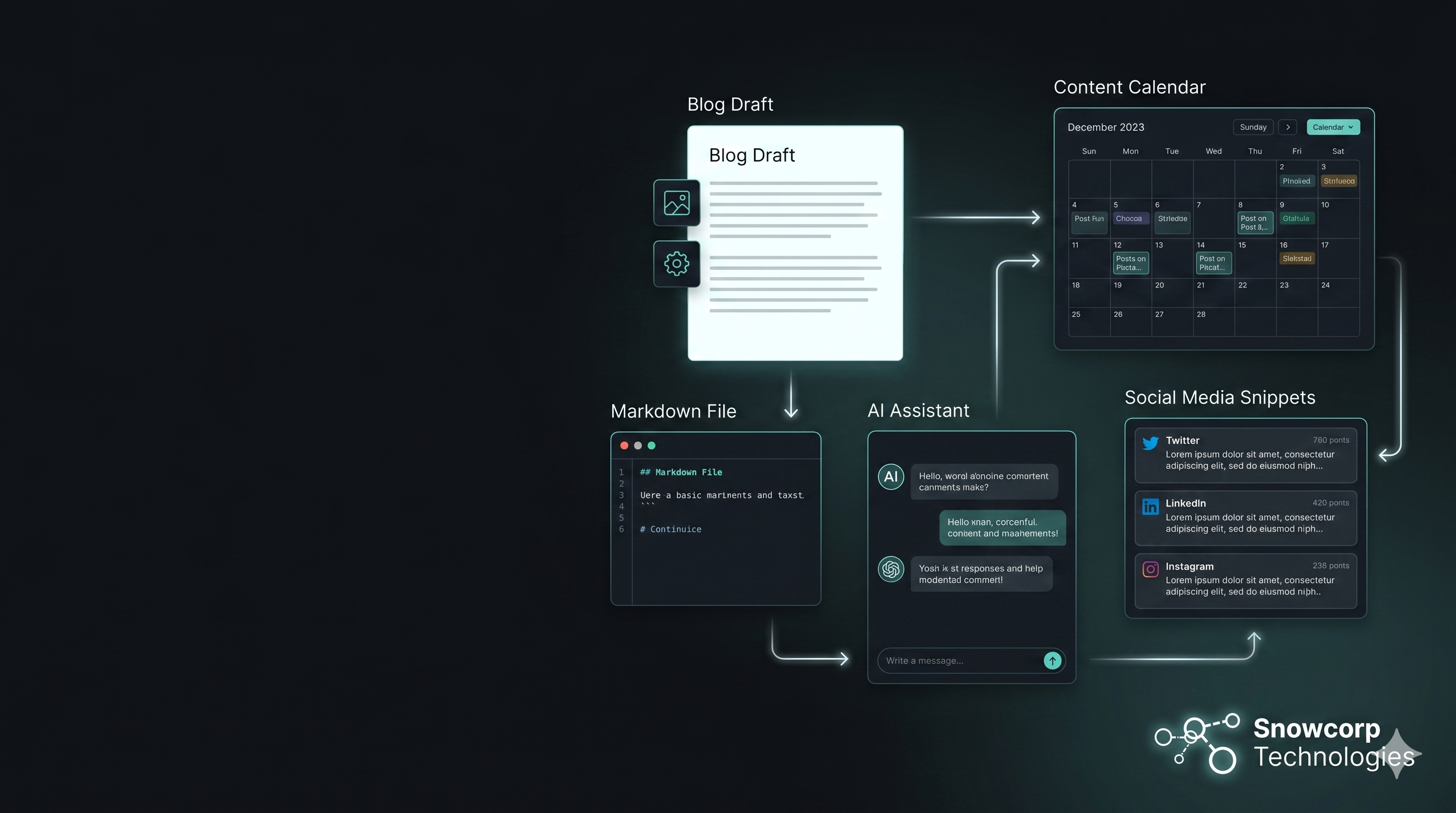
How to Build an AI Content Workflow for Your Business Website
Posted on May 31, 2026 • 4 minutes • 747 words
AI tools can speed up content production, but speed alone does not create results. The real advantage comes from building a repeatable workflow that helps your team research topics, avoid duplication, maintain quality, and publish consistently.
For many businesses, the content process breaks down in familiar places. Ideas are scattered across chats and spreadsheets, blog drafts repeat topics already published, social captions are written at the last minute, and nobody is fully sure which version is ready to go live.
A strong AI content workflow fixes that by giving every post a system. Instead of treating each article as a one-off task, you create a pipeline that moves from idea validation to drafting, editing, repurposing, and publishing.
Why workflow matters more than tools
Most teams start with the tool. They ask which AI writer, image generator, or SEO assistant they should use. That matters, but the bigger question is how content moves from concept to publication.
A useful workflow should do four things well:
- Prevent duplicate or overlapping topics.
- Turn rough ideas into structured drafts faster.
- Keep tone, formatting, and metadata consistent.
- Make distribution easier across LinkedIn, X, newsletters, and other channels.
When those pieces are in place, AI becomes an accelerator instead of a source of clutter.
Step 1: Keep a live content inventory
Before writing anything new, maintain a record of every published and planned post. This can live in a spreadsheet, Notion database, or simple markdown registry inside your Hugo project.
Your inventory should include:
- Title
- URL
- Publish date
- Primary keyword or topic
- Content status
- Owner
- Repurposing status for social channels
This simple step prevents one of the most common publishing mistakes: creating a “new” post that already exists in a slightly different form.
Step 2: Validate the topic before drafting
Not every topic deserves a full article. A quick validation step can save hours.
Before drafting, check:
- Has this topic already been published on your site?
- Does it solve a clear customer or reader problem?
- Can it support search intent, social engagement, or product awareness?
- Do you have something useful to say that goes beyond generic advice?
If the answer to most of these is yes, the topic is worth developing.
Step 3: Draft with structure first
AI works better when you give it structure. Instead of asking for a complete post in one prompt, build the article in layers:
- Working title
- Search intent
- Outline with key sections
- Brand voice notes
- Internal links to include
- Call to action
This approach produces more focused content and makes human editing easier. It also helps your team keep articles aligned with business goals rather than publishing loosely related content.
Step 4: Add a human review layer
AI-generated content should never go straight to publish. A fast editorial review improves trust and performance.
A reviewer should check:
- Accuracy of claims
- Brand tone and clarity
- Repetition or filler
- SEO basics such as title, description, headings, and internal links
- Whether the post offers practical value
Think of AI as your first draft partner, not your final editor.
Step 5: Repurpose at the same time
One blog post should create multiple assets. If you wait until after publishing to think about promotion, distribution often gets skipped.
At minimum, every finished article should generate:
- A feature image or image prompt
- A LinkedIn post
- An X post
- Suggested hashtags
- A short internal summary for your team
That turns one piece of writing into a content package instead of a single webpage.
Step 6: Publish with a checklist
For Hugo-based sites, publishing becomes easier when every article follows the same format. Use a checklist before going live:
- Front matter completed
- Slug reviewed
- Draft set correctly
- Feature image added
- Meta description written
- Headings checked
- Social copy prepared
- Final proofread complete
Checklists sound simple, but they reduce avoidable errors and make publishing less stressful.
Common mistakes to avoid
Even with AI, content quality drops when the workflow is unclear. Watch for these issues:
- Publishing without checking existing topics
- Writing broad posts with no audience intent
- Keeping AI wording that sounds generic
- Forgetting to create supporting social assets
- Treating blog content and distribution as separate tasks
The strongest teams build once and distribute everywhere.
Final thought
An AI content workflow is not about replacing people. It is about reducing friction so your team can spend more time on strategy, editing, and high-value ideas.
When your process includes a content inventory, topic validation, structured drafting, review, and repurposing, publishing becomes more consistent and much easier to scale.