7 Signs Your Business Needs a Custom Internal Tool
Posted on May 17, 2026 • 3 minutes • 633 words
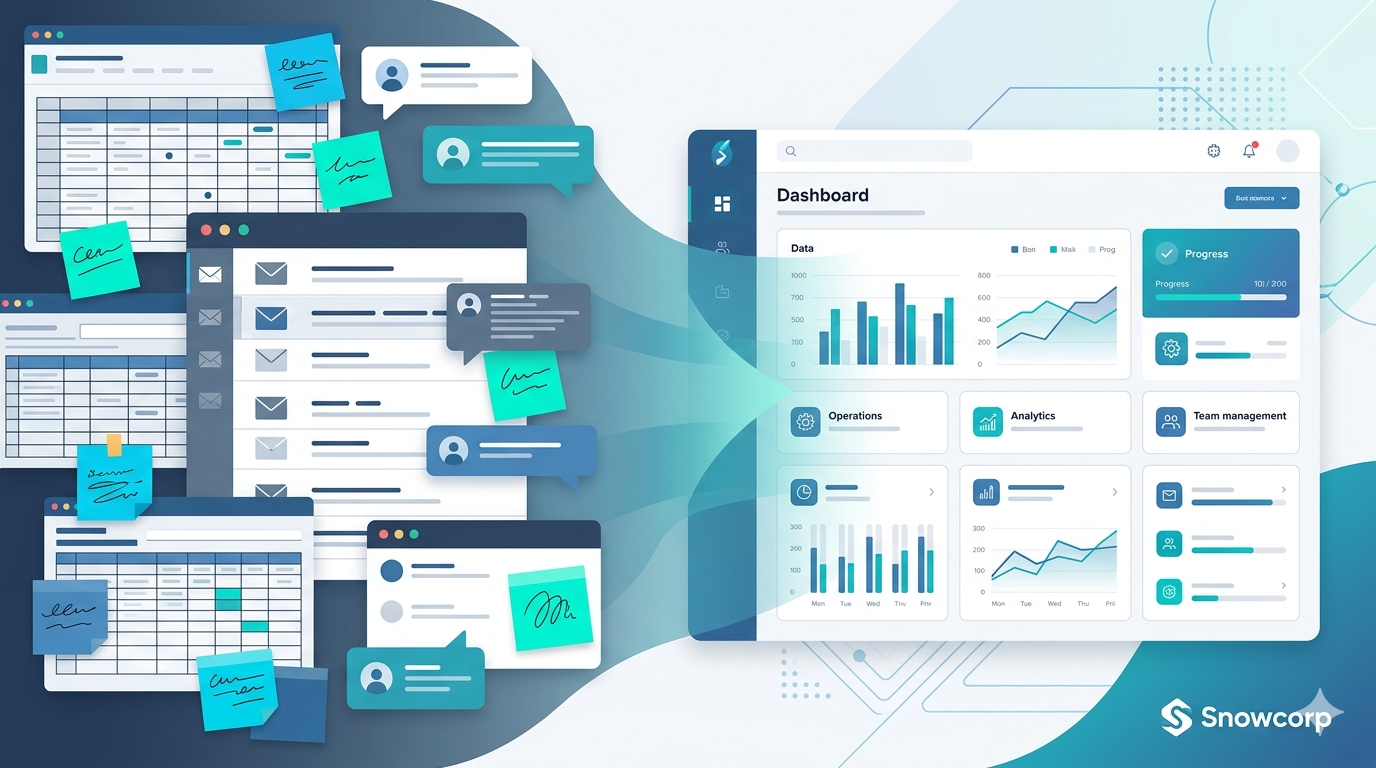
Many businesses do not notice operational friction until it starts affecting delivery speed, reporting accuracy, or customer experience. A process may still “work,” but if your team is stitching together spreadsheets, email threads, and manual updates every day, that process is already costing more than it appears.
A custom internal tool is not just for large enterprises. In many cases, it becomes the most practical option when off-the-shelf software no longer matches the way your business actually runs.
1. Your team is copying data between systems
If employees regularly move data from one app to another by hand, mistakes become inevitable. Duplicate entries, missed updates, and version confusion all grow as the business scales.
A custom internal tool can connect the exact systems your team already uses and reduce repetitive admin work.
2. Spreadsheets are running critical operations
Spreadsheets are useful, but they become risky when they start acting as your main workflow engine. If approvals, job tracking, inventory updates, or lead status depend on one or two fragile files, your process has outgrown the spreadsheet stage.
A dedicated tool gives you structure, permissions, auditability, and fewer hidden dependencies.
3. Your process does not fit any one SaaS product
Many businesses try to force unique workflows into generic tools. That usually creates workarounds: extra forms, duplicated tasks, and disconnected communication across departments.
A custom solution is valuable when your workflow is a competitive advantage or when adapting the business to the software creates more damage than adapting the software to the business.
4. Reporting takes too long
If your weekly or monthly reporting requires manual exports, copy-paste work, or cleanup before leadership can make decisions, the business is operating with delayed visibility.
A tailored internal dashboard can pull the right data into one place and make reporting part of the workflow instead of a separate burden.
5. Errors are becoming expensive
Small process mistakes can lead to delayed invoices, incorrect stock counts, support issues, or compliance problems. When the cost of errors starts rising, manual operations stop being “cheap.”
This is often the moment when a custom workflow, validation rules, and role-based access begin to produce a clear return.
6. Teams are relying on chat for process management
Chat tools are great for communication, but they are poor systems of record. If key updates live in message threads, people spend too much time searching, following up, and asking for status.
A custom internal tool creates one reliable place for tasks, ownership, progress, and history.
7. Growth is increasing complexity faster than headcount
When a business grows, operational complexity usually grows faster than the team. What worked for five people often breaks at fifteen.
Custom software helps teams scale without hiring only to keep up with coordination overhead.
When custom software makes sense
Not every business needs a fully bespoke platform. But custom internal tools are worth evaluating when:
- Your team repeats the same manual steps every day.
- Existing software forces awkward workarounds.
- Reporting is slow or unreliable.
- Errors are affecting revenue, delivery, or trust.
- Process complexity is increasing as the company grows.
The goal is not to build software for its own sake. The goal is to remove friction from the parts of the business that matter most.
How to start
A good first step is not “build everything.” Start by identifying one high-friction workflow with measurable business impact, such as approvals, lead routing, operations tracking, or internal reporting.
From there, define the users, the steps, the inputs, and the outcomes. A focused internal tool often delivers more value than trying to replace every workflow at once.
At Snowcorp, we help businesses design and build custom software that fits real operations instead of forcing teams into generic processes. The best internal tools are simple, specific, and aligned with how your team already works.